
.avif)





Payments Intelligence Platform vs Payment Orchestration: What's the Difference?
What Is Payment Orchestration?
Payment orchestration provides a technical control layer over a merchant's payment infrastructure.
Its primary objective is to route transactions efficiently across multiple providers.
A payment orchestration platform typically enables:
- Multi-PSP connectivity
- Smart transaction routing
- Failover routing
- Acquirer management
- Alternative payment methods
- Geographic payment optimization
- Gateway abstraction
- Vendor flexibility
Think of orchestration as the control tower directing payment traffic.
When a customer clicks "Pay", orchestration determines where that transaction should go.
What Is a Payments Intelligence Platform?
A Payments Intelligence Platform provides a business intelligence layer above the payment stack.
Its primary objective is to transform payment data into actionable insights.
Rather than routing transactions, it helps merchants answer questions such as:
- Why are approval rates falling?
- Which PSP performs best?
- Which payment routes generate the most revenue?
- Where is recoverable revenue being lost?
- Which markets are underperforming?
- How do we compare against similar merchants?
Think of payment intelligence as the cockpit dashboard for the entire business.
It doesn't execute payments.
It explains them.
The Fundamental Difference
The simplest way to understand the distinction is this:
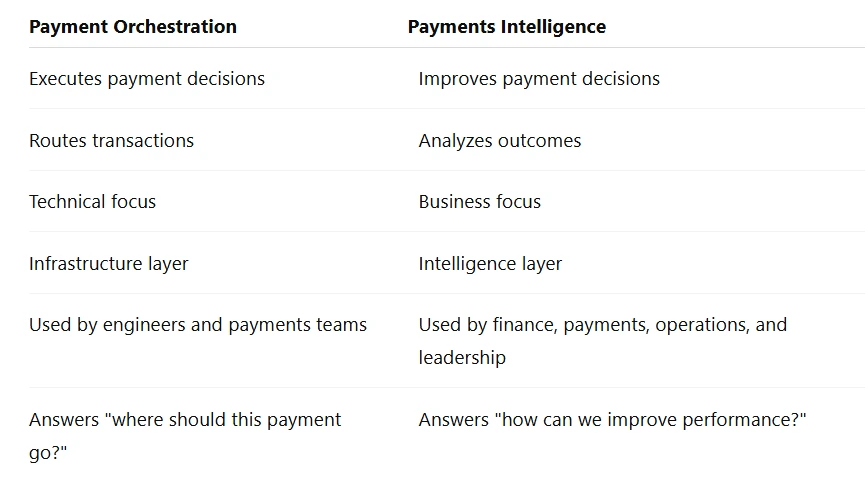
One acts.
The other learns.
Why Merchants Often Need Multiple Orchestration Solutions
Large merchants rarely operate in a simple payment environment.
Different regions require different:
- Acquirers
- Payment methods
- Regulatory frameworks
- Fraud tools
- Routing logic
As a result, merchants may use:
- Multiple PSPs
- Multiple acquirers
- Multiple orchestration providers
- Region-specific payment infrastructure
This creates flexibility.
But it also creates complexity.
Every new provider generates another source of payment data.
And that's where intelligence becomes essential.
The Problem Orchestration Doesn't Solve
Orchestration platforms are excellent at moving transactions.
But most are not designed to become the central source of truth for payment performance across the organisation.
They answer operational questions:
- Which route was selected?
- Which provider processed the payment?
- Was failover triggered?
Business teams need different answers:
- Why did approval rates decline in Germany?
- Which processor is most profitable?
- Which payment method drives the highest conversion?
- How much revenue is recoverable?
- Are chargebacks increasing?
- Which markets should we prioritize?
These questions extend beyond routing.
They require intelligence.
The Missing Layer in Modern Payment Stacks
Many merchants have built sophisticated payment infrastructure.
They have:
- Multiple PSPs
- Multiple acquirers
- Smart routing
- Failover systems
- Fraud tools
- Payment orchestration
Yet they still struggle to answer a simple question:
"How healthy are our payments?"
This happens because infrastructure alone does not create visibility.
Payment data remains fragmented across systems.
Teams rely on:
- PSP dashboards
- Orchestration reports
- BI tools
- Finance systems
- Spreadsheets
Nobody sees the complete picture.
A Payments Intelligence Platform solves this by creating a single source of truth across the entire payment ecosystem.
Who Uses Payment Orchestration?
Payment orchestration is primarily used by:
Engineering Teams
Managing integrations and reducing technical complexity.
Payment Operations Teams
Configuring routing logic and provider relationships.
Product Teams
Supporting expansion into new markets and payment methods.
Their focus is operational efficiency.
Who Uses a Payments Intelligence Platform?
Payment intelligence is used across the organisation.
Finance Teams
Understanding payment costs and reconciliation.
Payments Teams
Monitoring approval rates and provider performance.
Revenue Leaders
Identifying revenue recovery opportunities.
Operations Teams
Detecting issues before they become expensive.
Executives
Understanding overall payment health and growth opportunities.
Their focus is business performance.
Why the Future Is Orchestration + Intelligence
The next generation of merchants will not operate with a single PSP.
They will build increasingly sophisticated payment ecosystems.
That means more:
- Providers
- Payment methods
- Acquirers
- Markets
- Data
As complexity grows, two layers become essential:
Layer 1: Payment Orchestration
Optimizes how transactions flow.
Layer 2: Payments Intelligence
Optimizes how the business learns.
Together, they create a modern payment operating model.
One executes strategy.
One improves strategy.
How Unetix Fits Into the Stack
Unetix is not a replacement for your PSPs.
It is not a replacement for your acquirers.
And it is not a replacement for your orchestration platform.
Unetix is the missing intelligence layer.
It sits above your existing payment stack, consolidating payment data from multiple providers into a single platform where finance teams, payment teams, operations teams, and executives can monitor performance, benchmark results, identify opportunities, and make better decisions.
Because modern merchants don't just need more payment infrastructure.
They need better payment intelligence.
Conclusion
Payment orchestration and payment intelligence solve different problems.
Orchestration helps merchants route transactions efficiently.
Intelligence helps merchants understand, optimize, and grow.
The most successful merchants use both.
Because processing payments is important.
But learning from them is where the real competitive advantage begins.
{{cta}}


